
Peter & Sons in 2026: How Distinctive Design and New Partnerships Support Regulated-Market Growth
Peter & Sons entered 2026 as a comparatively young studio with a much larger international footprint than its age might suggest. Founded in 2019, the company has built its reputation around hand-drawn artwork, unusual characters, story-led settings and games that are intended to look recognisable before a player notices the supplier’s name. That creative identity now sits alongside a practical expansion strategy based on licences, local approvals, major operator agreements and distribution partners. The combination matters because regulated markets do not reward visual originality alone: a supplier must also prove that its games can be certified, localised, delivered reliably and supported over time.
A Recognisable Creative Identity as a Commercial Asset
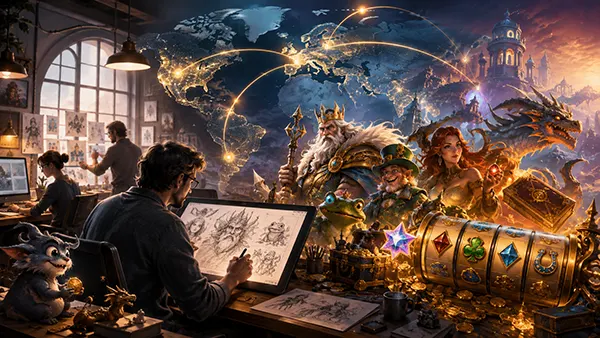
Peter & Sons describes itself as an international studio rather than a production line built around one visual formula. Its catalogue moves between folklore, crime comedy, fantasy, horror and historical adventure, yet the games usually share a similar sense of authorship. Characters tend to have exaggerated expressions, backgrounds resemble illustrated storybooks, and sound is used to reinforce the mood rather than simply fill pauses between spins. Releases such as Barbarossa Dragon Empire, Ghostfather Awakened, Zombie Road, Sand of Destiny and The Soapranos show how the studio can change subject matter without losing its signature.
This recognisable style gives the studio a useful position in crowded casino catalogues. Licensed operators already have access to thousands of slots, many of which use familiar themes, layouts and bonus structures. A smaller supplier therefore needs more than a large release schedule to earn visible placement. Peter & Sons can offer content that looks different in promotional banners, lobby thumbnails and game menus, while its recurring artistic habits help players connect separate releases to the same creator. That does not guarantee commercial success, but it gives operators a clear reason to test the games.
The studio’s growth has not required it to abandon that identity. In a March 2026 discussion published after ICE Barcelona, Peter & Sons said its team had grown to more than 60 people and that it was releasing over 24 original titles a year. That is a substantial schedule for an independent developer, but it remains smaller than the output of the largest suppliers. The advantage is focus: the company can increase production while still presenting each release as part of a carefully built world rather than an interchangeable addition to a long list.
How In-House Production Supports a Consistent Style
Peter & Sons stated in April 2026 that its art, animation, mathematics, sound and game mechanics are created in-house. This arrangement helps the studio keep the visual and functional parts of a title connected. An illustrator can work with the animation and sound teams from the beginning, while the designers responsible for the game rules can shape the pace around the theme. For players, the result is usually easier to understand than a game in which the art and features appear to have been developed separately.
In-house production also gives the company more control when a game must be prepared for several regulated jurisdictions. Market entry may require certified game versions, local language support, jurisdiction-specific settings and clear technical documentation. The core concept can remain the same, but the studio must be able to adjust and verify individual versions without weakening the original presentation. A closely connected internal team can make those changes more efficiently because the people responsible for the artwork, rules, sound and testing are working towards the same release plan.
Consistency is particularly valuable when a supplier enters a new country through an established operator. The first few releases often shape how local teams and players perceive the entire studio. Peter & Sons does not need every game to use the same characters or mechanics, but it benefits when each title reflects the same level of care. This makes creative identity more than a matter of appearance. It becomes evidence that the supplier can deliver a repeatable standard across different themes, languages and regulatory conditions.
Partnerships Turning Creative Work into Regulated Distribution
The most visible example of Peter & Sons’ 2026 expansion was its agreement with bet365. The initial rollout placed the studio’s games in the United Kingdom, Spain, the Netherlands and other selected regulated markets, with further launches named for Italy, Brazil, Ontario, Greece and Sweden. Working with an operator of that scale gives the studio access to several jurisdictions under one commercial relationship, while also requiring it to meet consistent expectations for certification, localisation, reliability and ongoing support.
Peter & Sons also used regional agreements to strengthen its position in individual markets. In March, its games went live with Entain brands in regulated Brazil through an existing relationship with Light & Wonder. In May, an agreement with Interwetten covered Germany, Greece, Spain and Sweden. The same month brought a deal with United Remote, combining wider distribution with direct access to Spanish brands such as PlatinCasino.es and FuegoCasino.es, as well as reach in Denmark and Germany. These arrangements show that the studio is not relying on one route or one operator group.
Further agreements widened that network during the second quarter. Digitain added a route to a broad group of operator brands in May, while ST8 focused on Ontario and the United Kingdom in June. GR8 Tech followed with international distribution through its casino technology business. Peter & Sons also announced launches with 12 Rank Interactive brands in the UK and with Tivoli Casino in Denmark. Each agreement has a different purpose: some offer broad reach, some provide strong local access, and others deepen the studio’s relationship with a specific regulated audience.
Why Several Distribution Routes Matter for an Independent Studio
A game supplier can sign separate agreements and complete a new connection for every operator, but that approach becomes slow and expensive as the number of markets grows. Aggregation and technology partners allow one approved catalogue to reach many licensed businesses through fewer connections. For Peter & Sons, this means the development team can spend more time on games and market preparation while commercial partners handle part of the delivery process. It also gives operators a simpler way to add the studio without rebuilding their technical setup for every release.
This model does not remove the need for compliance. Games still have to satisfy the rules of the country in which they are offered, and a title approved in one jurisdiction may require additional work elsewhere. What the partnership model changes is the route to market. An experienced distributor already understands the documentation, testing schedules and operator processes used in its target regions. That knowledge can reduce delays, especially for a studio entering several countries at once, but responsibility for accurate game information and reliable content remains shared across the supply chain.
Direct operator agreements remain important because they provide information that a broad distribution relationship may not capture. Rank Interactive can show how the studio performs across several established UK brands, Tivoli can provide a clearer view of Danish player response, and a localised operator can identify which themes are easier to present in its own market. Peter & Sons can then use those results when deciding which titles to certify next, how to plan language support and which creative ideas travel well without losing their character.
What Regulated-Market Growth Means in Practice
Regulated expansion is often described as a list of new countries, but the underlying work is more demanding. Peter & Sons’ website in 2026 identifies the Malta Gaming Authority and the UK Gambling Commission, alongside authorities connected with New Jersey, Ontario, Denmark, Sweden, Greece, Brazil, Italy, Germany, Buenos Aires and Spain. The exact legal route differs by jurisdiction: in some cases a supplier holds a direct licence, while in others content reaches players through local approvals, certified game versions and licensed partners. Treating every market as identical would create unnecessary compliance risk.
Localisation is also broader than translation. A game may need different information screens, betting configurations, promotional treatment or operating settings to match national rules. Operators may have their own standards for game descriptions, responsible gambling notices and release testing. Peter & Sons’ artistic approach can remain recognisable, but the surrounding product has to fit the local environment. This is one reason the studio’s agreements with companies already active in the UK, Spain, Ontario, Brazil, Germany, Greece, Sweden and Denmark are commercially useful.
Scale creates a further test. The Peter & Sons website states that the studio works with more than 1,000 operators worldwide, and its 2026 schedule combines frequent releases with a growing number of market launches. A large network increases visibility, but it also raises expectations for version control, support, documentation and timely fixes. Sustainable growth therefore depends on the less visible parts of the business as much as on the artwork. A distinctive game may attract attention, but dependable delivery determines whether operators continue to feature later releases.
The Next Stage of International Expansion
Peter & Sons’ next challenge is to keep its catalogue recognisable while adapting to a wider range of regulatory and cultural conditions. The risk for any fast-growing studio is that production targets begin to shape the games more strongly than creative decisions. Peter & Sons has so far presented in-house craft as a central part of its identity. Maintaining that approach while supporting more than two dozen annual releases will require disciplined scheduling, selective certification and a willingness to delay ideas that are not ready for several markets.
The studio’s July 2026 agreement with Hollywoodbets UK provides an example of how future growth may be planned. The immediate value lies in wider UK distribution, but the relationship was also presented as a possible bridge towards South Africa, where Hollywoodbets has deep operating experience. This type of partnership can help Peter & Sons understand a market before committing to a full rollout. It does not guarantee entry or performance, yet it offers a more informed route than launching through a partner with little local knowledge.
By the second half of 2026, Peter & Sons had moved beyond the stage of proving that its visual style could attract industry attention. The more relevant question was whether that style could support long-term relationships across regulated markets. Its agreements with large operators, regional brands and distribution specialists suggest a balanced answer: creative distinction opens commercial conversations, while compliance, localisation and dependable delivery turn those conversations into sustainable access. The studio’s future position will depend on preserving both sides of that model rather than treating design and regulation as separate priorities.